On this page
- How Barcelona Nightlife Actually Works
- The Best Neighbourhoods for a Night Out
- Clubs Worth the Queue
- Beach Clubs and Chiringuitos After Dark
- Bar-Hopping Routes That Actually Flow
- 2026 Budget Reality — What a Night Out Costs in Barcelona
- Staying Safe and Avoiding the Tourist Traps
- Frequently Asked Questions
💰 Click here to see Spain Budget Breakdown
💰 Prices updated: October, 2026. Budget figures are estimates — always verify before travel.
Exchange Rate: $1 USD = €0.88
Daily Budget (per person)
Shoestring: €60.00 – €90.00 ($68.18 – $102.27)
Mid-range: €120.00 – €180.00 ($136.36 – $204.55)
Comfortable: €220.00 – €470.00 ($250.00 – $534.09)
Accommodation (per night)
Hostel/guesthouse: €15.00 – €50.00 ($17.05 – $56.82)
Mid-range hotel: €70.00 – €130.00 ($79.55 – $147.73)
Food (per meal)
Budget meal: €7.00 ($7.95)
Mid-range meal: €25.00 ($28.41)
Upscale meal: €80.00 ($90.91)
Transport
Single metro/bus trip: €3.00 ($3.41)
Monthly transport pass: €24.00 ($27.27)
Barcelona‘s nightlife has always been magnetic, but 2026 has added a new layer of friction for visitors. The city council tightened venue capacity controls in late 2025, several iconic clubs relocated or rebranded, and the new Zona de Gran Afluència Turística rules mean some areas now have restricted late-night pedestrian access on weekends. None of this has killed the scene — it’s still one of Europe’s best — but showing up without a plan will cost you time, money, and possibly a spot at the door.
How Barcelona Nightlife Actually Works
If you’ve just arrived from London, Berlin, or New York, forget your internal clock. Barcelona operates on a different rhythm entirely, and fighting it is the fastest way to have a bad night.
Bars don’t fill up until after 11pm. Clubs rarely hit their stride before 2am. The real action — the packed dance floors, the live DJ sets, the energy that makes this city legendary — runs from around 3am to 6am. Locals eat dinner at 10pm, have drinks at midnight, and arrive at the club around 2am. That’s not exaggeration. That’s Tuesday.
Most clubs operate Thursday through Sunday. Friday and Saturday are the obvious peaks, but Thursday has become increasingly strong with student nights and emerging DJ showcases. Sunday sessions, called after parties locally, often run from Sunday afternoon into Monday morning and have a dedicated, committed crowd.
Dress code matters more than in many European cities. Barcelona clubs aren’t wildly formal, but trainers with joggers, football shirts, and flip-flops will get you turned away at the door — not because the bouncer is rude, but because that’s genuinely the standard. Smart casual is the minimum. For higher-end venues on the Port Olímpic strip, lean toward what you’d wear to a good restaurant.

One more thing: the city’s nightlife runs on a social media economy. Promoters slide into Instagram DMs offering free or discounted entry. This is legitimate — it’s how many venues fill their guest lists. If a stranger on Las Ramblas hands you a physical flyer and promises free entry, that’s a different story. The flyer model is almost exclusively used now to funnel tourists into overpriced tourist-trap venues.
The Best Neighbourhoods for a Night Out
Eixample — The Gay Village and Cocktail Bars
The stretch of Eixample known as Gayxample — centred around Carrer del Consell de Cent and Carrer de Muntaner — is Barcelona’s most reliably mixed, welcoming nightlife zone. The bars here run late, the crowds are stylish and sociable, and the energy stays consistent year-round rather than spiking only in summer. This is also where you’ll find some of the city’s best cocktail bars: serious mixology, not just gin and tonic poured over ice.
El Raval — Underground and Alternative
Raval has gentrified considerably since the early 2010s, but it still carries an alternative edge that Eixample lacks. The streets around Carrer de Joaquín Costa are dense with dive bars, craft beer spots, and small live music venues. The area gets a genuinely local crowd — art students, musicians, people who’ve lived in Barcelona for decades. It’s louder, rougher around the edges, and far more interesting than the polished versions of nightlife you’ll find elsewhere.
Born and Sant Pere — Premium Pre-Club
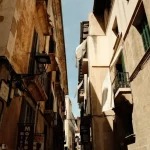
El Born is where you start the night, not where you end it. The bars here — especially around Passeig del Born and the streets fanning out from the Basílica de Santa Maria del Mar — are excellent for cocktails and wine from 9pm onwards. The neighbourhood empties out around 2am as people migrate toward clubs. It’s refined, relatively quiet compared to Raval, and genuinely beautiful to walk through at night, the medieval stone streets lit gold under street lamps.

Poble Sec — The Local Secret That’s Not So Secret Anymore
The bars along Carrer de Blai (famous for its pintxos) keep going well after the food stops. Poble Sec has attracted a younger local crowd displaced from Gràcia by rising rents, and the result is a neighbourhood with real energy and lower prices than the tourist-heavy zones. Several small clubs and late bars have opened here since 2024, making it a genuine destination rather than just a warm-up option.
Port Olímpic — Big Clubs, Big Crowds
The Port Olímpic strip is loud, expensive, and international. The clubs here — several of which have changed names or ownership since 2024 — are large, polished, and oriented toward a party-tourist crowd. The music is mainstream commercial and EDM. If that’s what you want, you’ll find it here in abundance. Go in knowing what it is: a reliable, high-energy, high-cost experience rather than a culturally authentic one.
Clubs Worth the Queue
Barcelona’s club scene has shifted since 2024. Some venues that dominated the 2010s have closed or lost their edge. The following are the names that locals and serious nightlife visitors are talking about in 2026.
Razzmatazz
Still the standard-bearer. Razzmatazz in Poblenou runs five rooms simultaneously, each with a different sound: indie, electronic, techno, pop, and an eclectic room that shifts by night. It holds around 5,000 people when fully operating, yet somehow manages to feel less impersonal than venues half its size. Doors open at midnight, but the rooms build slowly — arriving at 1:30am is ideal. The Lolita room (indie and alternative) and The Loft (minimal techno) consistently deliver the best sets.

Sala Apolo
Sala Apolo on Carrer Nou de la Rambla is a converted 1940s dance hall that hosts live concerts earlier in the evening and then transitions into its legendary Nitsa Club nights — one of Europe’s most respected electronic music nights, running since 1993. The ornate balconies, the worn wooden floors, and the smell of decades of sweat and cigarette smoke absorbed into the walls give it a texture you won’t find in a purpose-built club. International techno and house DJs treat a Nitsa booking as a mark of credibility.
Input
For serious techno, Input is the answer. A converted warehouse in the industrial edges of the city, it has a sound system that physically moves the air around you — the bass is something you feel in your chest before your ears register it. The crowd is knowledgeable and focused on the music. No VIP tables, no bottle service, no distractions. This is Barcelona’s closest equivalent to Berlin’s club culture, and the queue operates strictly on the door team’s judgment of whether you fit the vibe.
Pacha Barcelona
The Barcelona outpost of the Ibiza institution sits on the Port Olímpic waterfront. It’s glamorous, expensive, and books high-profile commercial electronic and house DJs. Table reservations essentially require a bottle purchase (€180–€350 and up in 2026). Standing entry is more affordable, and the production quality — lighting, sound, staging — is genuinely impressive. Don’t expect underground credibility. Do expect a spectacle.
Beach Clubs and Chiringuitos After Dark
One thing Barcelona offers that inland cities never can: dancing with your feet close to sand and the Mediterranean air carrying the bass out to sea.

The beach club scene runs from late May through early October, with peak programming in July and August. Opium (formerly Opium Mar, now rebranded under new ownership in 2025) continues to draw a glamorous, international crowd directly on Barceloneta beach. Tables on the open terrace fill from 11pm, the indoor club from 1am.
For something less polished, the chiringuitos — the informal beach bars — that operate late on Barceloneta and Nova Icària beaches offer a more relaxed alternative. A cold Estrella Damm, the bass from a portable speaker, and the sound of waves: it’s a genuinely different experience from the club circuit. The city council introduced stricter sound curfews for chiringuitos in 2025 (music must stop at 2am along most of the beach), so these are better for the earlier part of a night out rather than the finale.
Further north, Bogatell and Mar Bella beaches have a more local character. Mar Bella in particular has long been associated with Barcelona’s LGBTQ+ community and on summer evenings the beach bars here have an easy, sociable energy that starts early and runs until the curfew kicks in.
Bar-Hopping Routes That Actually Flow
A good Barcelona night needs geography to work. These routes are designed so that each stop flows naturally into the next without unnecessary taxi rides or dead ends.
The Raval to Apolo Route
- Start on Carrer de Joaquín Costa in Raval — pick any bar that looks full. This is the warm-up zone (10pm–midnight).
- Walk south to Bar Marsella on Carrer dels Escudellers — one of Barcelona’s oldest bars, the absinthe is ancient, the atmosphere is genuinely strange and wonderful. One drink here is enough.
- Continue to the Barri Gòtic for a bar with a terrace around Plaça Reial (midnight–1:30am).
- Walk ten minutes down Carrer Nou de la Rambla to Sala Apolo for Nitsa Club. Arrive between 1:30am and 2am for the right momentum.

The Born to Razzmatazz Route
- Begin at a cocktail bar on Passeig del Born (9pm–11pm). El Born Bar or any of the small craft spots on Carrer del Rec work well.
- Move to El Xampanyet on Carrer de Montcada for cava and anchovies — this iconic spot closes at midnight, so time it right.
- Walk northeast into Poblenou via Carrer de Pallars (30-minute walk or a short taxi). Stop at one of the design-bar openings that have clustered around Rambla del Poblenou since 2023.
- Arrive at Razzmatazz around 1:30am–2am. The Lolita room fills fastest — head there first.
2026 Budget Reality — What a Night Out Costs in Barcelona
Barcelona is no longer cheap, but it’s still more affordable than London or Amsterdam for a comparable night out. Here’s what to realistically budget in 2026.
Budget Night Out (€30–€50 per person)
- Pre-drinks from a supermarket or corner shop: €5–€8
- Two or three beers in a Raval or Poble Sec bar: €10–€14
- Entry to a mid-tier club or live venue on guest list: €10–€15
- Two drinks inside the club (beer or basic cocktail): €16–€20
- Metro home (runs 24 hours on Friday and Saturday nights): €2.40
Mid-Range Night Out (€80–€130 per person)
- Cocktails at a Born or Eixample bar (two drinks): €22–€28
- Dinner at a casual restaurant before midnight: €25–€35
- Club entry without guest list registration: €20–€30
- Four drinks inside a mid-to-upper venue: €40–€50
- Taxi home at 5am: €12–€18 depending on distance
Comfortable/Premium Night Out (€200+ per person)
- Late dinner at a high-end restaurant: €60–€90
- Entry to Pacha or similar: €25–€40
- Shared bottle at a club table (split among four): €80–€120 per person
- Private transfers: €30–€60

A few prices to know: a beer at a standard club bar costs €7–€10. A cocktail is €13–€18. Water (yes, you should drink it) is often €4–€6 inside clubs. Cloakroom fees run €3–€5 per item. The tourist tax that applies to overnight accommodation doesn’t affect nightlife venues directly, but the city’s 2025 entertainment levy increased the cost of large events by around 8%, and most venues have passed this on to ticket prices.
Staying Safe and Avoiding the Tourist Traps
Barcelona’s reputation for pickpocketing is not exaggerated. The areas around Las Ramblas, the Gothic Quarter late at night, and packed club queues are where most incidents happen. The method is almost always distraction — a bump, a question, a spilled drink — while an accomplice works your pockets or bag. Use a front-zip bag, keep your phone in a front pocket, and carry only the cash you plan to spend.
Drink spiking, while not epidemic, does occur, primarily in tourist-oriented bars around Port Olímpic and Las Ramblas. Never leave a drink unattended, and if something tastes strange, don’t finish it.
Unlicensed taxis — people offering rides outside clubs at 4am — should be avoided. Use the official taxi app Free Now or Cabify, both of which operate widely in Barcelona in 2026. Uber relaunched limited services in the city in mid-2025 but availability remains inconsistent.
The Barcelona Metro runs 24 hours on Friday and Saturday nights, which eliminates the need for a taxi entirely if you’re heading to a central neighbourhood. Check the L2, L3, and L5 lines, which connect the main nightlife zones to most accommodation areas.
Frequently Asked Questions
What time do clubs open in Barcelona?
Clubs typically open their doors between midnight and 1am, but the real energy doesn’t build until 2am or later. Locals rarely arrive before 2am on weekends. If you walk in at midnight, you’ll be dancing in an empty room. Plan to eat late, bar-hop until around 1:30am, then head to the club.

Do I need to book club entry in advance in Barcelona?
In 2026, advance registration is strongly recommended for popular venues. Most clubs offer free or discounted guest list sign-up through their official websites or apps. Walk-up entry is available but costs more — typically €15–€30 extra — and you’ll queue considerably longer.
Is Barcelona nightlife safe for solo travellers?
Generally yes, though standard precautions apply. The main risks are pickpocketing in crowded areas and scams around Las Ramblas. Reputable clubs have visible security and are well-lit internally. Solo female travellers report feeling comfortable in most venues, particularly in Eixample and El Raval. Avoid unlicensed taxis and always use official ride-hailing apps late at night.
What is the legal drinking age in Barcelona?
The legal drinking age in Spain is 18. Clubs enforce this at the door — bring a valid passport or national ID card. A driving licence from outside the EU is generally accepted at most venues, but a passport is the safest option. Some venues scan ID on entry as part of the 2025 capacity tracking regulations introduced by Barcelona city council.
Are there any new clubs or nightlife venues that opened in Barcelona in 2025 or 2026?
Yes. Several venues opened or relaunched in the Poblenou and Poble Sec areas since late 2024, reflecting the ongoing shift of the nightlife scene away from the tourist-heavy centre. A handful of mid-size clubs with a focus on live electronic acts have opened near the Rambla del Poblenou strip. Check local listings platforms like Resident Advisor or Barcelona’s own Guia del Ocio for current programming.
Explore more
Best Restaurants in Barcelona: A Local’s Guide to Eating Well
The 12 Best Day Trips From Barcelona (Montserrat, Girona & More!)
Barcelona Travel Tips: Your Essential Guide for First-Time Visitors
📷 Featured image by MIGUEL BAIXAULI on Unsplash.