On this page
💰 Click here to see Spain Budget Breakdown
💰 Prices updated: October, 2026. Budget figures are estimates — always verify before travel.
Exchange Rate: $1 USD = €0.88
Daily Budget (per person)
Shoestring: €60.00 – €90.00 ($68.18 – $102.27)
Mid-range: €120.00 – €180.00 ($136.36 – $204.55)
Comfortable: €220.00 – €470.00 ($250.00 – $534.09)
Accommodation (per night)
Hostel/guesthouse: €15.00 – €50.00 ($17.05 – $56.82)
Mid-range hotel: €70.00 – €130.00 ($79.55 – $147.73)
Food (per meal)
Budget meal: €7.00 ($7.95)
Mid-range meal: €25.00 ($28.41)
Upscale meal: €80.00 ($90.91)
Transport
Single metro/bus trip: €3.00 ($3.41)
Monthly transport pass: €24.00 ($27.27)
Planning a road trip through Andalusia in 2026 means navigating a region that’s simultaneously more accessible and more crowded than ever. New AVE connections have pulled some travellers off the roads, but they’ve also pushed others toward driving — the only way to reach the olive groves of Jaén, the white villages of the Sierra Nevada foothills, and the flamingo lagoons of the Doñana coast on your own schedule. If you’re renting a car and pointing it south, here’s how to do it properly.
The Route: How to Structure Your Andalusia Road Trip
The most logical approach in 2026 is a west-to-east arc starting in Seville, ending in Almería or Granada, and returning your car at a different drop-off point. One-way rental fees have come down significantly since 2024 as competition between Europcar, Hertz, and several Spanish-owned agencies like Drivalia has increased. Budget for a one-way fee of around €50–€80 depending on the agency and season.
A solid 10-day route looks like this:
- Seville — base for 2 nights, use the city as your launchpad
- Arcos de la Frontera — first white village, dramatic cliff position
- Ronda — overnight, the gorge and the old town deserve a full afternoon
- Antequera — dolmens, the Torcal rock formations, underrated lunch stop
- Granada — 2 nights minimum, base for Sierra Nevada access
- Úbeda and Baeza — Renaissance twin towns in Jaén, often skipped, never forgotten
- Cazorla Natural Park — optional wilderness loop before heading to Almería
- Almería and the Tabernas Desert — final leg, genuinely surreal landscape
If you only have 5–6 days, cut Jaén and Cazorla and focus on the Seville–Ronda–Granada triangle. It’s well-travelled but it works for a reason.
What the Landscape Actually Looks Like
Most people picture white villages and sun. What they don’t expect is how dramatically the terrain shifts within a few hours of driving.
Leaving Seville on the A-92, the land is flat and agricultural — sunflowers in summer, bare ploughed earth in winter. The air through an open window smells faintly of dust and something green and herbal you can’t quite name. Then the road climbs. By the time you reach the Serranía de Ronda, you’re weaving through pine forest and limestone karst, the temperature dropping noticeably even in July.
Drop south from Ronda toward Málaga province and the vegetation changes again — scrub, almond trees in silver-grey rows, then the sudden shock of the Mediterranean coast glittering below. Turn inland toward Granada and the Sierra Nevada appears like a wall: snow-capped well into May, with ski infrastructure visible from the valley floor even in spring.
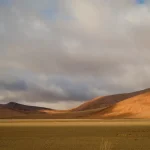
The final eastern section is where Andalusia genuinely surprises people. The Tabernas Desert near Almería is the only true desert in continental Europe — cracked, copper-red, and so alien-looking that filmmakers used it for dozens of Spaghetti Westerns in the 1960s and 1970s. Several film sets still stand, and driving through them on an empty weekday morning, the silence is total apart from wind and the occasional distant bird.
The Roads Themselves: What to Expect Behind the Wheel
Andalusia’s road network is genuinely good. The main autopistas (A-roads) are well-maintained, toll-free in most sections, and sign-posted clearly in Spanish and English on major routes. The A-92, which links Seville to Granada to Almería, is the backbone of this trip and poses no difficulty.
The mountain roads are a different matter. The route from Ronda up into the Sierra Nevada involves tight switchbacks, no crash barriers in places, and oncoming trucks that use the centre of the road until they don’t. Drive these sections in daylight, give yourself more time than Google Maps suggests, and don’t trust the speed limits posted — the legal limit on those curves is often optimistic.
As of 2026, Spain’s DGT (Directorate General of Traffic) has fully rolled out its updated speed camera network across Andalusia’s secondary roads. Average-speed cameras now cover long stretches of the A-92 and several provincial roads. The system photographs your plate at entry and exit points and calculates your average speed. Fines start at €100 and can reach €600 for serious violations.
Fuel prices in 2026 average around €1.65–€1.80 per litre for unleaded (95). Electric vehicle charging infrastructure has improved substantially along the main corridors — Seville, Granada, and Almería all have fast chargers — but the mountain and rural sections remain sparse. If you’re renting an EV, plan charges carefully and carry the Chargemap or Electromaps app.
Where to Eat Along the Route
One of the genuine pleasures of driving rather than taking the train is stopping to eat where the locals actually eat, not where the station café leaves you.
In Arcos de la Frontera, the weekly market sells jamón serrano from the nearby Sierra de Cádiz. Buy it here — it’s cheaper and better than anything you’ll find in a tourist shop in Seville. The town has a handful of small tapas bars around the Plaza del Cabildo where a cold manzanilla sherry and a plate of chicharrones (pork crackling) costs under €5 total.
In Antequera, try porra antequerana — a thicker, richer cousin of salmorejo, served cold with hard-boiled egg and tuna. Practically every bar in town serves it, and it costs €2–€3 for a generous bowl. The texture is dense and silky, almost like eating a very cold, very savoury mousse.
Jaén province is olive oil country. The olive groves stretch to every horizon — 60 million trees, they say, the largest concentration on earth. Stop at a roadside almazara (olive mill) and buy a litre of cold-press AOVE (extra virgin olive oil) directly from the producer. Prices run €6–€10 per litre for quality oil that would cost three times that in a city deli.
In Almería city, the tapas culture is still refreshingly old-school: order a drink and receive a free tapa automatically, no charge. The local specialty is migas — fried breadcrumbs cooked with garlic, chorizo, and green peppers. It sounds humble. It tastes extraordinary, especially with a cold Alhambra beer after a long day’s drive.
2026 Budget Reality: What This Road Trip Actually Costs
Andalusia is not as cheap as it was five years ago, but it remains one of the more affordable long-drive destinations in Western Europe. Here’s a realistic breakdown for a 10-day trip for two people sharing costs.
Car Rental (10 days, standard car)
- Budget tier: €280–€350 (economy car, basic insurance, high-season availability varies)
- Mid-range: €400–€550 (compact SUV, full coverage insurance, flexible fuel option)
- Comfortable: €650–€900 (automatic transmission, premium insurance, no deposit hold)
Accommodation (per night, per room)
- Budget tier: €45–€70 (hostels with private rooms, basic pensiones)
- Mid-range: €85–€130 (two-star hotels, rural casas rurales, small boutique stays)
- Comfortable: €150–€250 (paradores, converted convents, four-star hotels in historic centres)
Daily Food and Drink (per person)
- Budget tier: €20–€30 (market food, tapas bars, menú del día at €12–€15)
- Mid-range: €35–€55 (sit-down lunches, evening meals at local restaurants)
- Comfortable: €70–€100 (quality restaurants, wine with meals, occasional splurge)
Fuel for the full route (approximately 1,100 km) will cost around €90–€110 in a standard petrol car at current prices. Parking in most Andalusian towns runs €1–€2 per hour in pay-and-display zones, or €8–€15 for an overnight garage.
Overnight Stops Worth Slowing Down For
Not every stop on this route deserves an overnight. Antequera is excellent for lunch and the Torcal walk but thin on evening atmosphere. Almería city surprises people — it’s frequently passed over in favour of the coast, but the old Moorish Alcazaba and the genuinely untouristy tapas scene make it one of the best final-night stops on the whole circuit.
Ronda is the obvious overnight and earns it. The town thins out dramatically after 6pm when the day trippers leave, and what remains is a quiet, authentically Andalusian place. Walk the Puente Nuevo bridge at dusk when the gorge light turns amber and the swifts circle the cliffs below. Staying here also positions you perfectly for an early morning drive south before the heat builds.
Úbeda is the most underrated overnight on the entire route. The Renaissance Plaza de Vázquez de Molina is one of the most architecturally coherent squares in Spain — all honey-coloured sandstone and ecclesiastical symmetry — and almost nobody is there after dinner. The parador here occupies a 16th-century palace and charges mid-range prices by Andalusian standards (around €130–€160 per night).
Cazorla, if you include the natural park loop, rewards staying two nights. The park covers over 200,000 hectares of pine forest, river gorges, and wildlife — red deer, golden eagles, and Iberian wild goat are all regularly spotted. The village itself is small and unpretentious, built into a cliff face, with a ruined castle above and a loud, cheerful local bar culture below.
Frequently Asked Questions
Do I need an international driving permit to drive in Andalusia in 2026?
EU licence holders need no additional permit. Drivers from the UK, USA, Canada, and Australia need an International Driving Permit (IDP) alongside their national licence. These cost very little and are issued by national motoring associations. Rental agencies increasingly ask to see them at pick-up in 2026, so carry both documents.
What is the best time of year for an Andalusia road trip?
March to early June and mid-September to November are ideal. Summer temperatures in inland Andalusia regularly exceed 40°C, making midday driving genuinely unpleasant and some mountain roads dangerous due to tyre pressure issues. Spring brings wildflowers, cooler mountain passes, and far lower accommodation prices than July or August.
Can I visit the Tabernas Desert as a day trip from Granada or Almería?
From Almería city, Tabernas is about 35 kilometres — a straightforward 30-minute drive. From Granada it’s roughly 170 kilometres, making it a long but manageable day trip. The desert is best in early morning or late afternoon; midday in summer is brutally hot with virtually no shade available on most of the accessible terrain.
Are the roads to the white villages (pueblos blancos) suitable for regular rental cars?
Most are fine in a standard car. Roads to popular villages like Arcos, Grazalema, and Zahara de la Sierra are paved and regularly maintained. Very narrow village streets and steep gradients mean a smaller car is genuinely easier to manoeuvre. Avoid large SUVs unless you’re confident with tight turns and have good spatial awareness.
How far in advance should I book accommodation on this route in 2026?
For travel between June and September, book at least 6–8 weeks ahead, especially in Ronda and Granada. The Cazorla area has limited hotel stock and sells out quickly in spring walking season (April–May). Outside peak season, two weeks’ notice is usually sufficient, and last-minute deals are genuinely available at smaller pensiones and casas rurales.
📷 Featured image by Niklas Jonasson on Unsplash.