On this page
💰 Click here to see Spain Budget Breakdown
💰 Prices updated: October, 2026. Budget figures are estimates — always verify before travel.
Exchange Rate: $1 USD = €0.88
Daily Budget (per person)
Shoestring: €60.00 – €90.00 ($68.18 – $102.27)
Mid-range: €120.00 – €180.00 ($136.36 – $204.55)
Comfortable: €220.00 – €470.00 ($250.00 – $534.09)
Accommodation (per night)
Hostel/guesthouse: €15.00 – €50.00 ($17.05 – $56.82)
Mid-range hotel: €70.00 – €130.00 ($79.55 – $147.73)
Food (per meal)
Budget meal: €7.00 ($7.95)
Mid-range meal: €25.00 ($28.41)
Upscale meal: €80.00 ($90.91)
Transport
Single metro/bus trip: €3.00 ($3.41)
Monthly transport pass: €24.00 ($27.27)
Spain’s famous city breaks are getting harder to enjoy in 2026. Queues at the big monuments, rising hotel rates and packed tapas bars leave many travellers feeling like extras in someone else’s crowd. Zaragoza sits almost exactly between Madrid and Barcelona, has more history than most Cities twice its size, and still feels like a place where people actually live. So is it Spain’s most underrated city break? For travellers who want substance without the stress, it makes a strong case.
Why Zaragoza Gets Overlooked (and Why That Helps You)
Zaragoza is the capital of Aragón, with around 680,000 people. Most visitors pass through on a train between the two big cities and never get off. There is no single poster image like the Sagrada Família or the Alhambra, so it rarely appears on first-time itineraries.
That is exactly the appeal. You can walk into a 17th-century basilica without a timed ticket, order a drink in a bar where the staff are not speaking English by default, and cross the Ebro river without a single selfie stick in your way. The city is flat, compact and easy to read. In a country where “undiscovered” usually means “three hours from anywhere”, Zaragoza is the rare exception: a major city with real character, reachable in about 90 minutes from either Madrid or Barcelona.
Four Eras in One Walkable Centre
Zaragoza was the Roman city of Caesaraugusta, a Moorish taifa capital, a Christian medieval kingdom’s seat and a Baroque pilgrimage centre. All of it is within a 20-minute walk.
Basílica del Pilar
The basilica rises beside the Ebro with its eleven tiled domes. Inside, the ceiling frescoes include early work by Goya. When the bells start, the sound rolls across the huge Plaza del Pilar and bounces off the stone. You can take a lift up one of the towers for a view over the river and the rooftops.
La Seo and Mudéjar Aragón
A short walk away, La Seo cathedral shows several centuries of style layered together. Its exterior wall of brick and coloured tile is a textbook example of Mudéjar art, a Christian-Muslim building tradition that is part of Aragón’s UNESCO World Heritage listing.
The Aljafería
This 11th-century palace is the finest Moorish building in northern Spain. The courtyard has slim arches, plaster carved like lace and a quiet orange-tree garden. Part of it is now the regional parliament, so you may see officials crossing the same stone floors as visitors.

Roman Caesaraugusta
Four small museums mark the Roman city: the forum, the river port, the baths and the theatre. They are modest but well designed, and you can see them in half a day. Stretches of the old Roman wall still stand near the Mercado Central.
Outside the centre, the Expo 2008 site has the Torre del Agua and Zaha Hadid’s Bridge Pavilion. It is a useful contrast, and the riverside paths are pleasant for a late-afternoon walk.
Where to Eat: El Tubo and Beyond
El Tubo is the knot of narrow lanes behind the Plaza del Pilar where Zaragoza does its tapas. At 13:00 or after 20:30, the air smells of garlic, frying oil and grilled mushrooms, and small bars spill onto the street. You do not sit down. You order a pincho, a caña and move on.
- El Champi: famous for a skewer of garlicky mushrooms topped with a prawn. The room is small and loud, which is part of the fun.
- Bodegas Almau: an old-style grocery and wine bar. Good for cured meats, local cheese and Aragonese wine.
- Calle Estébanes: the central tapas lane. Walk it end to end and stop wherever the counter looks busiest.
For a sit-down meal, look for ternasco de Aragón, a tender young lamb roasted until the skin is crisp. Other local dishes include migas (fried breadcrumbs with chorizo and grapes), borrajas (borage, a green vegetable) and longaniza sausage. For dessert, try frutas de Aragón, candied fruit dipped in chocolate.
For wine, ask for a garnacha from nearby Cariñena, Campo de Borja or Calatayud. Most bars pour them by the glass for little money.
Getting There and Around by AVE, Bus and Tram
Zaragoza is one of the best-connected cities in Spain for rail. AVE trains from Madrid Atocha take about 1 hour 15 minutes to 1 hour 30 minutes. From Barcelona Sants the fastest services take around 1 hour 30 minutes to 1 hour 45 minutes. Competition on this corridor is a big change since 2024: Renfe now shares the line with Ouigo and Iryo, and advance fares have dropped as a result.

All trains arrive at Zaragoza-Delicias, a large station about 3 km from the old town. Take a city bus or a taxi (around €8–12) to reach the centre. There is also an airport with limited low-cost flights, but for most travellers the train is faster and simpler.
Once you are in the centre, you can walk almost everywhere. The tram’s north-south line passes Plaza del Pilar and is useful for reaching the Aljafería side of town. Bizi Zaragoza, the public bike-share, works well along the flat riverside routes.
Day Trip or Overnight?
Many people visit Zaragoza as a day trip from Madrid or Barcelona, and it works if you start early. You could see the Pilar, La Seo, the Aljafería and a long tapas lunch between a 09:00 train and an evening return. But it is rushed, and you miss the best hour: the city after sunset, when the basilica is lit up and El Tubo is at full volume.
One night is the sweet spot for a quick stop. Two nights let you add the Roman museums and the Expo site at a slower pace. Add a third day for an excursion from Zaragoza:
- Monasterio de Piedra: a waterfall park around an old monastery, roughly 1.5–2 hours away by car.
- Tarazona: a Mudéjar town with a striking cathedral, about an hour away.
- Fuendetodos: Goya’s birthplace, around 45 km south.
- Huesca: a calm provincial capital, reachable by regional train.
Zaragoza Budget Reality in 2026
Prices here sit noticeably below Madrid and Barcelona. These are typical 2026 ranges per person per day, not including long-distance transport.
- Budget (€55–80): hostel bed or basic hotel room (€25–55 shared or €55–75 private), a menú del día at €14–16, pinchos at €2.50–4 each, and entry to one or two sights.
- Mid-range (€110–170): a central three- or four-star hotel (€90–140 per room), a tapas crawl, a sit-down dinner at €25–35, and a couple of museum tickets.
- Comfortable (€200+): a high-end hotel (€160 and up), a ternasco dinner with local wine at €35–50 per person, taxis and a guided tour.
Typical entry prices are around €4–6 for the Pilar tower and the Roman museums, and about €5 for the Aljafería, which is usually free on Sundays. The basilica itself is free to enter. Advance high-speed train tickets can start around €10–20 on Ouigo and Iryo, and €25–45 on Renfe. At the time of writing, Zaragoza does not charge a tourist tax, but check before you travel as local rules can change.

Practical Tips Most Visitors Learn Too Late
- Respect the cierzo. This dry, cold northwest wind can blow hard in winter and spring. A windproof jacket makes a bigger difference than a thick sweater.
- Follow local meal times. Lunch runs about 14:00–16:00, and most restaurant kitchens do not open for dinner until 20:30–21:00. Tapas bars are more flexible.
- Check Monday hours. Several museums close on Mondays, so plan your Roman sites and Goya collections for other days.
- Visit the Pilar early. Mornings are quiet. By midday, pilgrim groups and school visits arrive.
- Plan around October. The Pilar festival around 12 October brings parades and music but also higher hotel prices, so book well ahead.
So, is Zaragoza Spain’s most underrated city break? Probably. It has big-city monuments, serious food and fast trains, without the crowds that now define the better-known destinations. Two unhurried days here can feel more rewarding than a rushed weekend somewhere louder.
Frequently Asked Questions
Is Zaragoza worth visiting for a city break?
Yes. Zaragoza packs Roman ruins, a Moorish palace, Mudéjar towers and a huge basilica into a compact centre. Tapas are cheaper than in Madrid or Barcelona, crowds are thinner, and high-speed trains make it easy to add to a Madrid–Barcelona trip. Two days is enough to see the highlights.
How many days do you need in Zaragoza?
Two days works well: one for the Pilar, La Seo, Roman sites and El Tubo, and one for the Aljafería, the Expo 2008 area and the riverside. Add a third day if you want a trip to Monasterio de Piedra or Tarazona. A single day is possible but rushed.
How long is the train from Madrid and Barcelona to Zaragoza?
High-speed AVE trains from Madrid Atocha take about 1 hour 15 minutes to 1 hour 30 minutes. From Barcelona Sants, the fastest services take around 1 hour 30 minutes to 1 hour 45 minutes. Both arrive at Zaragoza-Delicias station, a short bus or taxi ride from the old town. Operators include Renfe, Ouigo and Iryo.
What is Zaragoza famous for?
Zaragoza is famous for the Basílica del Pilar, a major pilgrimage site, and for its Mudéjar architecture, partly UNESCO-listed. It is also known for Goya’s early work, the Aljafería palace, the El Tubo tapas quarter and the October Pilar festival, which fills the streets with parades, music and giant figures.
When is the best time to visit Zaragoza?
Spring (April to early June) and autumn (September to October) bring mild days of 18–25°C. Summer often passes 35°C, and winter can be cold and windy because of the cierzo. October is lively thanks to the Pilar festival, but hotels fill up and prices rise around 12 October.
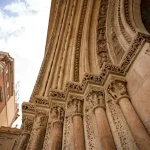
📷 Featured image by Christian Hergesell on Unsplash.