On this page
- Getting Out of Barajas in 2026: What’s Changed and What Hasn’t
- Metro Line 8: The Fastest and Cheapest Option for Most Travellers
- The Cercanías Train (Line C1): Best for Sol, Atocha, and Central Stays
- Express Airport Bus (Exprés Aeropuerto): When It Makes Sense
- Licensed Taxis: What to Expect at the Rank in 2026
- Ride-Hailing Apps (Uber, Cabify, FreeNow): How They Work at Barajas
- Private Transfers and Shuttle Services: Worth It or Not?
- 2026 Budget Reality: Cost Comparison Across All Options
- Practical Arrival Tips: Terminals, Luggage, and Timing
- Frequently Asked Questions
Getting Out of Barajas in 2026: What’s Changed and What Hasn’t
Madrid‘s Barajas Airport handled over 62 million passengers in 2025, and in 2026 it remains one of the busiest in Europe. That means the arrivals area at Terminal 4, in particular, can feel genuinely overwhelming — especially at peak hours in July and August or during holiday weekends. The good news is that the city has solid public transport connections and the journey into central Madrid is straightforward once you know which option matches your situation. The less good news: prices have crept up across the board since 2024, the taxi supplement rules were updated in early 2026, and some ride-hailing pickup points moved. This guide cuts through the noise and tells you exactly what to do when you land.
Metro Line 8: The Fastest and Cheapest Option for Most Travellers
For the vast majority of travellers, the Metro is the right answer. Line 8 — the pink line — connects all four terminals directly to the city centre, running from T1/T2/T3 (one combined station) and T4 (its own station, Aeropuerto T4) into Nuevos Ministerios, where you can change onto Lines 6, 10, and other key routes. The full journey from T4 to Nuevos Ministerios takes about 20 minutes. From there, a few more stops puts you at Alonso Martínez, Gran Vía, or Sol depending on which line you transfer to.
The Metro runs every 5–7 minutes during the day and roughly every 10–15 minutes late at night. It operates from approximately 06:00 to 01:30 daily. There is no overnight service, so if you land after 01:30, you’ll need a taxi or ride-hailing app.
One practical note on luggage: the Metro cars have reasonable space near the doors, and the escalators at the airport stations are wide. But if you’re travelling with a large suitcase and a carry-on, you’ll want to position yourself carefully in the carriage — the morning commute between 08:00 and 09:30 packs people in tightly.

The Airport Supplement: What You’ll Actually Pay
Madrid Metro has a specific airport surcharge that catches a lot of first-time visitors off guard. In 2026, the supplement for travelling to or from any of the four airport stations is €3.00 on top of your regular fare. A single Zone A Metro ticket costs €1.50–€2.00 depending on distance, so a typical journey into the centre will cost around €4.50–€5.00 total. If you have a Multi card (the rechargeable travel card sold at Metro machines), the supplement still applies, but the base fare is cheaper. You cannot use a standard 10-trip card (Metrobús/Abono) to cover the airport supplement — it must be paid separately on the Multi card.
The Cercanías Train (Line C1): Best for Sol, Atocha, and Central Stays
The Cercanías suburban rail network is genuinely underused by tourists, and that’s a shame because it’s often a better option than the Metro depending on where you’re staying. Line C1 runs from Aeropuerto T4 through Chamartín (the main northern rail hub), then continues to Recoletos, Atocha Renfe, and beyond towards Alcobendas in the other direction.
If your hotel is near Atocha station — which covers a large chunk of the Lavapiés, Retiro, and southern Huertas neighbourhoods — the C1 drops you right at the door in about 25 minutes from T4. The fare is significantly cheaper than the Metro: a single Cercanías ticket from the airport into the city centre is around €2.60 in 2026 with no airport surcharge.

The catch is frequency. Cercanías C1 runs every 15–30 minutes depending on the time of day, and services are thinner on Sundays and public holidays. Check the Renfe app or the electronic boards at the T4 train station before committing to this option if your flight lands late at night. The station is directly connected to the T4 arrivals hall — follow the brown “Cercanías” signs, not the Metro signs, which are blue.
Express Airport Bus (Exprés Aeropuerto): When It Makes Sense
The Exprés Aeropuerto bus — line 203 — runs between Barajas and Atocha bus station 24 hours a day, seven days a week. That last point is the key one: it’s the only public transport option that runs all night. Between midnight and 06:00, buses run every 35 minutes. During the day, they run every 15–20 minutes.
The route stops at T1, T2, T3, and T4, then travels via the M-40 and M-30 motorways into the city, stopping at O’Donnell, Cibeles, and finally Atocha. The journey time varies significantly: as little as 40 minutes during off-peak hours, but closer to 60–70 minutes during Madrid’s brutal rush hour between 08:00 and 10:00 or 17:00 and 20:00.
In 2026, the single fare on the Exprés Aeropuerto is €5.00. You pay with a contactless card, the EMT app, or cash on board. The Multi card is accepted for this route. Given the Metro’s reliability and speed, the bus makes most sense in two scenarios: overnight arrivals when the Metro is closed, or when you’re staying in the Retiro or Atocha area and want a direct connection without changing trains.

A word about luggage on the bus: there’s a hold underneath where large bags go, and the driver or a ground attendant will help you load it. This is actually more comfortable than wrestling a 25-kilogram suitcase onto a Metro carriage during peak hours.
Licensed Taxis: What to Expect at the Rank in 2026
Madrid taxis are white with a red diagonal stripe, and they are licensed and metered. At Barajas, taxis pick up from designated ranks outside each arrivals terminal — look for the “Taxi” signs with the green-and-white livery of the rank marshals.
Since January 2026, Madrid updated its airport taxi regulations. There is now a flat rate of €33.00 for journeys between any of the four terminals and any destination within the M-30 ring road (which covers most of central Madrid, including Sol, Gran Vía, Malasaña, Chueca, and La Latina). This flat rate replaced the old metered system for airport journeys, and it includes all supplements — no extra charges for luggage, night travel, or public holidays within this zone.
For destinations outside the M-30 but still within the city (think Carabanchel, Vallecas, or northern districts like Fuencarral), the meter applies from the airport boundary, and fares will typically run €38–€50 depending on distance and traffic. Always confirm with the driver before departure that you’re getting the flat rate if applicable.
Queue times at the taxi rank vary enormously. On a Tuesday afternoon, you might wait five minutes. On a Friday evening in August after three long-haul flights land simultaneously, expect 25–35 minutes. The organised queue system works well — don’t jump it, the marshals watch closely.
Ride-Hailing Apps (Uber, Cabify, FreeNow): How They Work at Barajas
Uber, Cabify, and FreeNow all operate legally at Madrid Airport in 2026 under Spain’s VTC (private hire vehicle) licensing system. They are not the same as taxis and operate from separate pickup zones — an important distinction that confuses a lot of arrivals.

At T4, the VTC pickup area is on Level 0 of the departures building, a short walk from the arrivals exit. At T1, T2, and T3, pickup is in the car park area — follow the signs for “VTC” or “Vehículo de Transporte con Conductor”. The apps will show you a meeting point with a specific bay number once your driver is assigned. If you follow the taxi signs, you’ll end up in the wrong place.
Pricing for ride-hailing into central Madrid typically runs €28–€45 depending on the app, time of day, and surge pricing. In comparison to the flat-rate taxi (€33), Cabify is often slightly cheaper during off-peak hours, while Uber tends to surge aggressively during late-night arrivals. FreeNow sits in the middle. All three apps show the estimated price before you confirm the booking, so compare before you commit.
One practical advantage of ride-hailing over taxis: you can book before you even clear passport control, and the driver tracks your arrival. On the downside, wait times at busy periods can stretch to 15–20 minutes as drivers circle or queue in the holding area, whereas taxis are immediately available at the rank.
Private Transfers and Shuttle Services: Worth It or Not?
Pre-booked private transfers — where a driver meets you in arrivals with a name sign — are a legitimate option, particularly for groups of three or more, families with young children, or business travellers who want certainty. In 2026, reputable operators charge €45–€65 for a standard saloon car to central Madrid, and €65–€90 for a minivan or people carrier handling larger groups or a lot of luggage.
The meeting point is typically the arrivals hall itself, which means no hunting for parking zones or VTC bays in an unfamiliar airport. You’ve confirmed the price in advance. The driver will often help with bags, and many services offer child seats on request at no extra cost.

Shared shuttle services also exist, where multiple passengers share a vehicle to different city centre drop-offs. These are cheaper per person (around €15–€20 per person) but take longer due to multiple stops, and scheduling is rigid — if your flight is delayed by two hours, you may miss your allocated shuttle and need to rebook. Unless cost is the primary concern, private transfers offer better value than shared shuttles once you factor in the time lost.
For solo travellers or couples, the honest assessment is that private transfers are a comfort choice, not a value choice. The Metro and taxi deliver comparable results at lower cost. But for a family with three kids, two pushchairs, and six bags arriving after a 10-hour flight, that €65 transfer suddenly looks very reasonable.
2026 Budget Reality: Cost Comparison Across All Options
Here’s a clear picture of what you’ll actually spend getting from Barajas to central Madrid in 2026:
- Budget: Metro Line 8 — approximately €4.50–€5.00 per person including the airport supplement. Fastest door-to-door if your hotel is near a Metro stop.
- Budget (overnight only): Exprés Aeropuerto bus — €5.00 per person. Only viable all-night option. Slower but comfortable for luggage.
- Mid-range (rail): Cercanías C1 — approximately €2.60 per person. Cheapest of all if it suits your destination, but less frequent.
- Mid-range (taxi/ride-hail): Licensed taxi flat rate — €33.00 total (not per person). For two or more people splitting the cost, this is excellent value and beats the Metro hands down.
- Mid-range (ride-hail): Uber/Cabify/FreeNow — €28–€45 depending on timing and surge. Variable but often comparable to taxis.
- Comfortable: Pre-booked private transfer — €45–€65 for a standard car. Best for families, groups, or late-night arrivals who want a guaranteed, hassle-free experience.

A few things have changed since 2024 worth flagging: the taxi flat rate zone was extended and standardised in January 2026, which actually made taxis more predictable and slightly cheaper for some routes. The Metro airport supplement has not increased since 2023 despite general fare rises. And the Cercanías fare got a marginal reduction as part of the Spanish government’s continued rail subsidy programme, which was renewed for 2026.
Practical Arrival Tips: Terminals, Luggage, and Timing
Madrid Barajas has four terminals, and which one you arrive at matters for your onward journey:
- T1, T2, T3: All connected to the same Metro station (Aeropuerto T1-T2-T3) and the same bus stops. Mostly EU/Schengen flights and some short-haul international routes.
- T4 and T4S: The large modern terminal designed by Richard Rogers, used by Iberia and its Oneworld partners plus some long-haul arrivals. Has its own Metro station (Aeropuerto T4) and its own Cercanías station. T4S is a satellite building connected to T4 by an underground shuttle — add 10 minutes to your walking time.
If you’re arriving at T4 and connecting to the Metro, you’ll smell the cool recycled air of the underground station even before you see it — the signage is good, and the walk from arrivals to the platform takes about 8 minutes at a normal pace, a little longer with heavy bags on the moving walkways.
On timing: Madrid’s rush hour is real and unforgiving. The M-40 and M-30 motorways, used by both taxis and shuttle buses, can back up severely between 07:30–09:30 and 17:30–20:00 on weekdays. If you land during these windows and are in a hurry, the Metro is almost always faster than any road-based option. Outside these hours, taxis are quick and comfortable.

Baggage reclaim at Barajas typically takes 20–40 minutes after touchdown, which means your ground transport wait time is rarely wasted — by the time you clear customs and collect your bags, most Metro and taxi queues have settled.
One final sensory note: stepping out of the T4 arrivals hall on a summer evening, you’ll hit the dry heat of Madrid immediately — often still 32°C or higher at 21:00. Have water in your bag before you join any queue, and make sure your phone is charged. You’ll need it either for the Metro app, your ride-hailing booking, or simply Google Maps to confirm which exit to use.
Frequently Asked Questions
How long does it take to get from Madrid Airport to the city centre?
By Metro Line 8, the journey from T4 to Nuevos Ministerios takes about 20 minutes, then a few more stops to Sol or Gran Vía. By taxi on the flat rate, expect 25–40 minutes depending on traffic. The Exprés Aeropuerto bus takes 40–70 minutes depending on the time of day and traffic conditions on the M-30.
Is there a direct train from Madrid Airport to the city centre?
Yes. The Metro Line 8 is the most direct, running from all four terminals into central Madrid with connections at Nuevos Ministerios. The Cercanías Line C1 also operates from T4, stopping at Chamartín and Atocha. Neither requires a separate booking — just a valid ticket purchased at the station.
What is the cheapest way to get from Madrid Airport to downtown?
The Cercanías C1 train is the cheapest at around €2.60 per person, but it only serves T4 and has limited frequency. The Metro (€4.50–€5.00 including the airport supplement) is nearly as affordable and much more frequent. For two people travelling together, the €33 taxi flat rate works out comparably to two Metro tickets with far more convenience.

Do taxis from Madrid Airport charge extra for luggage or night journeys?
No. Under the 2026 flat-rate system, the €33.00 fare for journeys within the M-30 ring road covers all supplements — luggage, night travel, public holidays, and tolls. You should not be charged anything extra on top of this fixed rate. If a driver tries to add supplements, ask for a receipt and report it to the Madrid taxi authority (EMT).
Can I use Uber at Madrid Airport?
Yes. Uber operates legally at Barajas under Spain’s VTC licensing system. You book through the app as normal, but pickup is from designated VTC zones — not the taxi rank. At T4, the VTC pickup area is on Level 0 of the departures building. Expect prices of €28–€45 to central Madrid, with surge pricing possible during late-night arrivals or busy periods.
Explore more
The Ultimate Guide to Day Trips from Madrid: Explore Beyond the Capital
The Best Day Trips from Madrid: Unforgettable Escapes Near the City
Best Neighborhoods in Madrid, Spain — Area-by-Area Guide
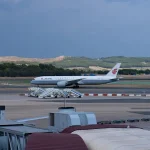
📷 Featured image by Adrián Valverde on Unsplash.