On this page
- What Kind of City Is Bilbao Really?
- The Guggenheim and the Art Scene Beyond It
- Eating in Bilbao — Pintxos, Michelin Stars, and the Market in Between
- The Casco Viejo — What to Do and What to Skip
- Getting to Bilbao in 2026
- Getting Around the City
- Day Trip or Overnight?
- 2026 Budget Reality
- Practical Tips for 2026
- Frequently Asked Questions
💰 Click here to see Spain Budget Breakdown
💰 Prices updated: October, 2026. Budget figures are estimates — always verify before travel.
Exchange Rate: $1 USD = €0.88
Daily Budget (per person)
Shoestring: €60.00 – €90.00 ($68.18 – $102.27)
Mid-range: €120.00 – €180.00 ($136.36 – $204.55)
Comfortable: €220.00 – €470.00 ($250.00 – $534.09)
Accommodation (per night)
Hostel/guesthouse: €15.00 – €50.00 ($17.05 – $56.82)
Mid-range hotel: €70.00 – €130.00 ($79.55 – $147.73)
Food (per meal)
Budget meal: €7.00 ($7.95)
Mid-range meal: €25.00 ($28.41)
Upscale meal: €80.00 ($90.91)
Transport
Single metro/bus trip: €3.00 ($3.41)
Monthly transport pass: €24.00 ($27.27)
Bilbao is finally getting the attention it deserves — and that’s creating a problem. In 2026, visitor numbers have climbed steadily, the Guggenheim queue stretches longer than ever on summer mornings, and Airbnb pressure in the Casco Viejo has pushed some locals out of their own neighbourhood. The Basque Regional government introduced an updated tourist tax framework in late 2025 that now applies across all accommodation types in Bilbao, including short-term rentals. None of this means you shouldn’t go. It means you need to go smarter — knowing which parts of the city reward your time, which are genuinely overrated, and how to eat and drink like someone who actually lives here.
What Kind of City Is Bilbao Really?
Bilbao is not a postcard city. It doesn’t have Seville’s grandeur or Barcelona’s beach. What it has is something harder to manufacture: a strong working-class identity that survived the collapse of its steel and shipbuilding industries in the 1980s, reinvented itself through culture and cuisine, and never forgot where it came from.
The city sits in a river valley in the Basque Country, hemmed in by green hills on every side. The Nervión river runs through the middle, and the city’s personality shifts as you cross it. The Casco Viejo — the old town — is compact, loud, and full of pintxos bars. The Ensanche, built in the 19th century on a grid plan, feels more bourgeois: wide boulevards, serious restaurants, upmarket shops. The waterfront Abandoibarra district, where the Guggenheim sits, is the shiny regeneration zone that the rest of Europe studied in the 1990s as a model for post-industrial renewal.
Basque identity is real and present here — not performed for tourists. You’ll see ikurrina flags on balconies, Euskara (the Basque language) on street signs alongside Spanish, and a genuine pride in local food, sport, and culture that has nothing to do with flamenco or paella. Bilbao is Basque first, Spanish second, and tourists are welcome as long as they understand that order.
The Guggenheim and the Art Scene Beyond It
Yes, you should go to the Guggenheim. Frank Gehry’s titanium curves still stop people in their tracks even decades after it opened, and the permanent collection — including Richard Serra’s towering The Matter of Time — is genuinely worth the €16–18 entry fee (prices vary by exhibition in 2026). The Serra installation alone, a series of enormous curved steel walls that you walk through, is one of the most physically affecting art experiences in Europe. The way the steel smells faintly of rust and the sound of your footsteps changes as the corridor narrows around you — nothing prepares you for that.
Book tickets online at least two or three days ahead in July and August. Walk-up queues in summer 2026 are running 60–90 minutes. The museum is closed on Mondays.
But the Guggenheim is only the start. The Museo de Bellas Artes (Fine Arts Museum), a ten-minute walk away in Doña Casilda park, holds one of the best collections of Spanish and Basque art in the country. Entry is €10, crowds are minimal, and it closes for free entry on Sundays. You’ll find El Greco, Goya, and Sorolla alongside important Basque painters like Ignacio Zuloaga — artists who rarely feature on the standard Spain art circuit.
The Azkuna Zentroa (formerly the Alhóndiga) is a different kind of cultural experience: a former wine warehouse converted by designer Philippe Starck into a civic centre with a rooftop pool, a cinema, a library, and rotating contemporary art exhibitions. The 43 columns holding up its atrium are each decorated in a different historical style — Byzantine, Gothic, Art Deco — which sounds chaotic but somehow works. Entry to the common areas is free.
For contemporary Basque art with a political edge, the Bilbaoarte Foundation supports local emerging artists and hosts free exhibitions in the Casco Viejo. The work shown here tends to be rougher, more experimental, and more honest about Basque social history than the glossy Guggenheim programming.
Eating in Bilbao — Pintxos, Michelin Stars, and the Market in Between
The Basque Country has more Michelin stars per square kilometre than almost anywhere on earth. In Bilbao itself, that translates to a food culture where even a quick snack at a bar counter is taken seriously. The local bar snack — the pintxo — is a small bite served on bread or a skewer, and in the Casco Viejo, the best bars line the streets of Calle del Perro, Calle de la Tendería, and Calle Jardines. The rule is simple: grab a plate, pick what looks good from the bar counter, order a zurito (a small beer, the local measure), and pay when you leave.
Bar Gatz on Calle Santa María is consistently one of the best — the anchovy on a slice of idiazabal cheese pintxo alone is worth finding. Berton Saskia on Calle Jardines does outstanding hot pintxos made to order rather than sitting on the counter getting stale, which puts it a level above most competitors. Budget €20–30 per person for a proper crawl through five or six bars in an evening.
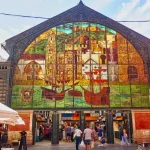
For a sit-down meal without the Michelin price tag, the Mercado de la Ribera on the riverfront is the right place. It’s the largest covered market in Spain, a magnificent Art Deco building from 1929, and the upper floor has a food hall with proper cooked dishes, fresh seafood, and local produce at honest prices. A full lunch here runs €12–18 per person. Go on a weekday morning to see it as a working market rather than a tourist attraction.
If you want one serious meal in Bilbao, Nerua, the Guggenheim’s own restaurant run by chef Josean Alija, has one Michelin star and serves modern Basque cuisine with an almost obsessive focus on local ingredients. A tasting menu runs €130–150 per person in 2026, excluding wine. Reserve weeks ahead. For something slightly more accessible, Mina, across the river near the Mercado de la Ribera, holds one star and offers a lunch menu at around €85 — exceptional value for the quality.
The Casco Viejo — What to Do and What to Skip
Bilbao’s old town, known locally as the Siete Calles (Seven Streets), is the oldest part of the city and the social heart of its bar culture. The streets are narrow, the buildings tall, and on weekend evenings the noise of hundreds of conversations spilling from open bar doors creates a particular kind of beautiful chaos.
The Plaza Nueva is the architectural centrepiece — a neoclassical arcaded square built in the early 19th century that hosts a Sunday morning market selling antiques, stamps, coins, and second-hand books. It’s one of those places that looks better on an overcast Basque morning than in bright sunshine, the grey stone fitting the mood of the city.
The Catedral de Santiago is the main church, a Gothic structure with a pretty cloister that most visitors walk past. It’s free to enter and rarely crowded. The Basílica de Begoña, a steep 20-minute walk up from the old town to a hilltop above it, is the spiritual centre of Basque Catholicism and offers the best free views over the city.
What to skip: the souvenir shops along Calle Somera selling mass-produced Basque paraphernalia have multiplied in 2026 and are worth walking past. The pintxos bars directly on the tourist trail near the metro entrance on Arenal tend to serve mediocre food at inflated prices. Walk one street further in any direction and you’ll find something better.
Getting to Bilbao in 2026
Bilbao is well connected but often skipped in favour of the bigger Spanish cities. That’s changing. Bilbao Airport (BIO), designed by Santiago Calatrava, is about 12 kilometres from the city centre and handles direct flights from most major European cities. Vueling, Iberia, Ryanair, and easyJet all operate routes here, with new direct connections from Dublin and Manchester added to their 2026 summer schedules. The airport bus (Bizkaibus A3247) runs every 20–30 minutes to the city centre for around €3. A taxi costs approximately €30.
By rail, Bilbao sits on the Renfe network but is not currently served by high-speed AVE. The fastest train from Madrid via Vitoria-Gasteiz takes around five hours on the Alvia service (€30–70 depending on booking window). There are regular services from San Sebastián (1 hour 20 minutes, around €10) and Santander (approximately 2 hours). The long-debated Basque Y high-speed rail project — which would connect Bilbao, San Sebastián, and Vitoria to the Spanish AVE network — has seen construction progress in 2025–2026 but is not expected to open until the early 2030s at the earliest.
From Barcelona, the most practical option is to fly (90 minutes) rather than take the long train journey through the north of Spain. From San Sebastián, the bus via PESA or the train are both comfortable and frequent — many people combine both cities in a single Basque Country trip.
Getting Around the City
Bilbao’s Metro is clean, efficient, and designed by Norman Foster — the glass canopy entrances, known locally as fosteritos, are a minor architectural landmark in themselves. Two lines cover the main tourist areas and the beaches at Getxo and Plentzia on the coast (a 40-minute ride from the centre). A single fare is €1.75; a ten-trip Barik card brings this down to around €0.85 per journey and is available at Metro stations.
The EuskoTran tram line runs along the river from the Casco Viejo through Abandoibarra (Guggenheim) and out to the western suburbs. It’s the most pleasant way to move between the old town and the museum district. Tickets are €1.75 or use the same Barik card.
The city centre is highly walkable. From the Casco Viejo to the Guggenheim is about 25 minutes on foot along the river — a genuinely pleasant walk that passes Zubizuri (the white footbridge by Calatrava) and the Ayuntamiento (city hall). Cycling infrastructure has improved significantly since 2024, with new protected lanes along the Nervión waterfront.
Day Trip or Overnight?
If you’re based in San Sebastián (about 100 kilometres east), Bilbao works as a long day trip — just about. You can do the Guggenheim, a pintxos crawl in the Casco Viejo, and the Fine Arts Museum in one full day if you start early and move efficiently. But you’ll miss the evening atmosphere, which is when Bilbao is most itself: bars filling up at 20:00, the noise rising, a zurito at the counter of somewhere with no English menu.
Two nights is the sweet spot for most visitors. It gives you time to explore the Casco Viejo without rushing, do both major museums, eat one serious meal, and maybe take the Metro out to the coastal suburb of Getxo on the estuary — an underrated half-day trip with a beach, a marina, and a very different, quieter side of Basque life.
If you’re coming from Madrid or Barcelona specifically to see Bilbao, three nights makes sense. You could add a day trip to San Sebastián or the Rioja Alavesa wine region (less than an hour by car), both of which pair naturally with a Bilbao base.
2026 Budget Reality
Bilbao is not cheap, but it’s significantly more affordable than San Sebastián and comparable to Madrid outside the summer peak.
- Budget (€70–110/day): Hostel dorm or basic guesthouse (€25–45/night), self-guided pintxos meals at the bar (€20–25/meal), public transport, free museums on Sunday, Guggenheim skipped or visited on a discount day.
- Mid-range (€150–220/day): 3-star hotel in the Ensanche or Casco Viejo (€90–130/night), one sit-down restaurant lunch with wine, pintxos evenings, Guggenheim plus one other paid museum, Metro and tram as needed.
- Comfortable (€280–400+/day): Design hotel or boutique property near the Guggenheim (€160–250/night), one Michelin-adjacent dinner, full museum programme, occasional taxi. Nerua or Mina lunch adds €85–150 per person.
The Basque tourist tax introduced under the updated 2025–2026 regional framework adds €1–3 per person per night depending on accommodation category. Hotels collect this automatically; it’s worth checking whether it’s included in the quoted price when booking independently.
Pintxos at the bar counter typically cost €2–4 per piece. A zurito of beer costs €1.50–2.50. A full lunch menu (menú del día) at a local restaurant runs €13–18 including wine and dessert.
Practical Tips for 2026
Language: Spanish works everywhere. Euskara (Basque) greetings are genuinely appreciated — kaixo (hello) and eskerrik asko (thank you) will earn you a warmer reception in local bars. English is widely understood in tourist areas and hotels but less reliable in traditional pintxos bars.
When to go: June and September are the best months — warm but not overwhelmingly hot (Bilbao typically reaches 22–26°C in summer), and crowds are lighter than July and August. The Semana Grande festival in August fills the city with events and people; accommodation prices spike and book out weeks ahead. January to March is quiet, grey, and rainy — the Basque Country gets a lot of Atlantic weather — but hotels are at their cheapest and the museum experience is genuinely uncrowded.
Etiquette: In pintxos bars, don’t hover and grab everything at once. Take a plate, make one selection, eat it, then go back. Pay at the end, on the honour system, and don’t be shocked if the bartender just asks how many you had rather than itemising. This system works because locals are honest about it — visitors should be too.
Accommodation areas: The Ensanche (grid district) offers the best combination of central location, transport access, and reasonable pricing. The Casco Viejo is atmospheric but loud on weekend nights. Abandoibarra (Guggenheim district) has upmarket hotels at premium prices and little local character.
Sunday logistics: Many shops in the Casco Viejo close on Sundays, but the Plaza Nueva market runs until around 14:00, and bars and restaurants are open. The Fine Arts Museum is free on Sundays. The Guggenheim charges full price every day it’s open.
Frequently Asked Questions
Is Bilbao worth visiting beyond the Guggenheim?
Absolutely. The Fine Arts Museum rivals any in Spain, the Casco Viejo pintxos scene is one of the most authentic food experiences in the country, and the city’s Basque identity gives it a character you won’t find elsewhere. Most visitors who come only for the Guggenheim leave wishing they’d stayed longer.
How many days do you need in Bilbao?
Two nights covers the essentials comfortably — both major museums, the Casco Viejo, a proper evening pintxos crawl, and a sit-down meal. Three nights allows day trips to the coast or San Sebastián. One day is feasible from a nearby base but you’ll feel rushed and miss the evening atmosphere entirely.
Is Bilbao expensive compared to other Spanish cities?
Mid-range to moderately expensive. More affordable than San Sebastián, roughly comparable to Madrid. Pintxos bar eating is genuinely good value at €2–4 per piece. Hotels in the Ensanche offer fair prices for quality. Michelin dining is a splurge but the lunch menus at starred restaurants offer better value than dinner.
What is the best neighbourhood to stay in Bilbao?
The Ensanche district is the most practical base — central, well-connected by Metro and tram, close to the Fine Arts Museum, and quieter than the Casco Viejo at night. It offers a range of hotel options from budget to comfortable mid-range. The Casco Viejo is atmospheric but can be noisy on Thursday through Saturday nights.
Do I need to speak Spanish or Basque to visit Bilbao?
Spanish is sufficient everywhere. English is understood in hotels and tourist areas. Knowing a few words of Euskara — kaixo for hello, eskerrik asko for thank you — is genuinely appreciated in local bars and will often get you a warmer response than speaking English or Spanish. Nobody expects fluency.
📷 Featured image by Catrin Ellis on Unsplash.